
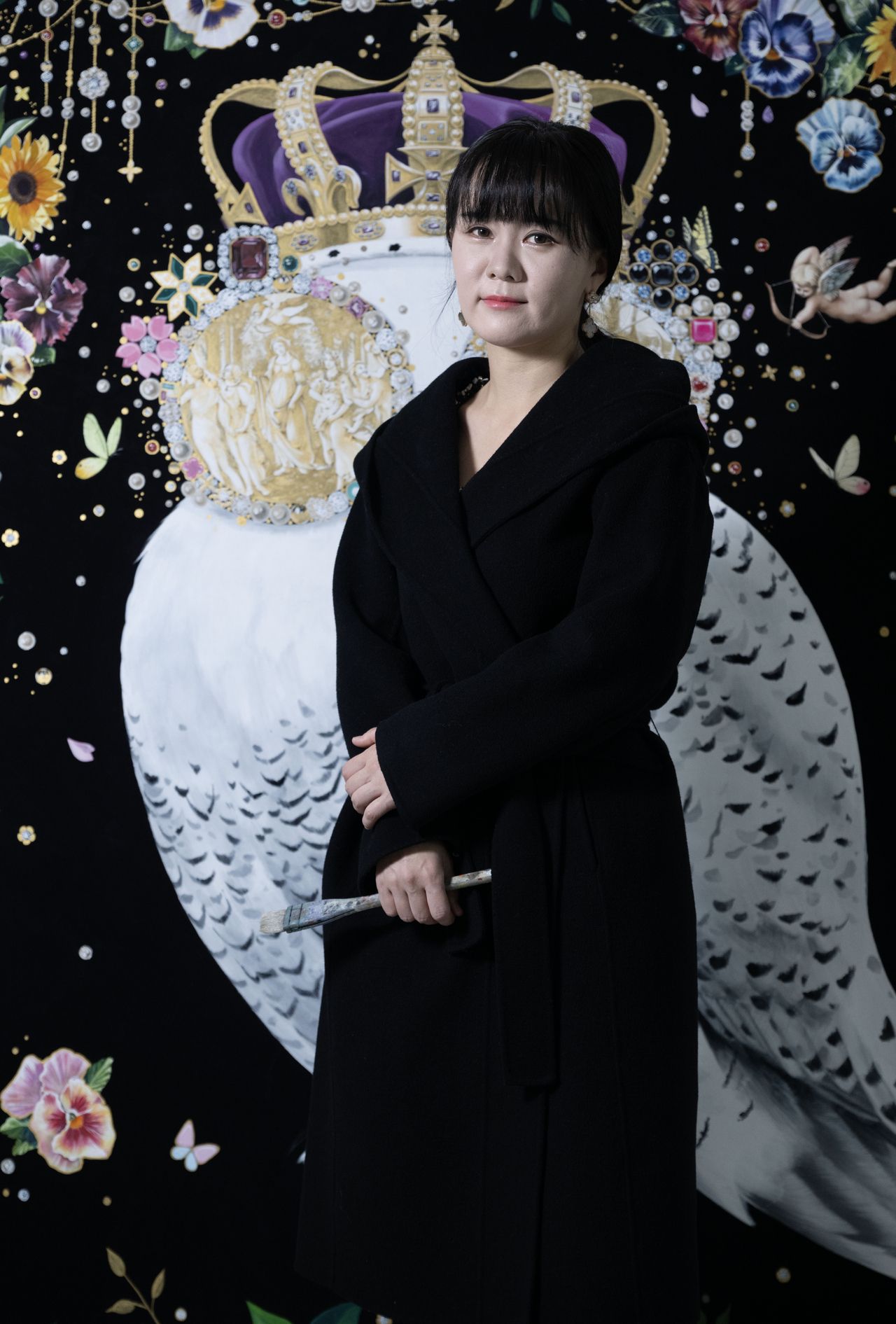
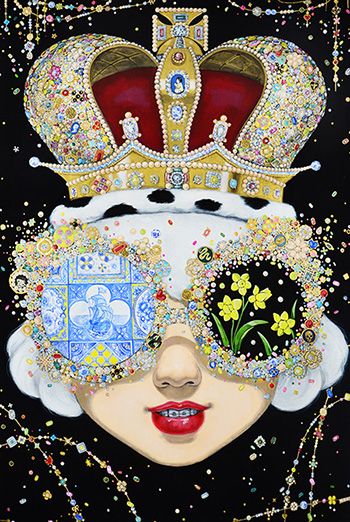
 Kim Ji-hee paints countless faces — often crowned and ornamented with exaggerated jewel-laden styling. Smiling behind heavily embellished glasses, the figures appear glamorous, immediately drawing viewers to their brilliance.
But upon closer inspection, the smiles appear increasingly artificial in some way, even melancholic, inviting questions about what lies behind the splendid glasses. The painting series, titled “Sealed Smile,” began in 2008, created with Korean traditional painting techniques.
“Glasses both conceal and reveal. They partially cover the face, without showing everything, yet invite curiosity about who the person underneath really is,” Kim said in an interview with The Korea Herald at her studio in Gangnam-gu, Seoul, on Dec. 18.
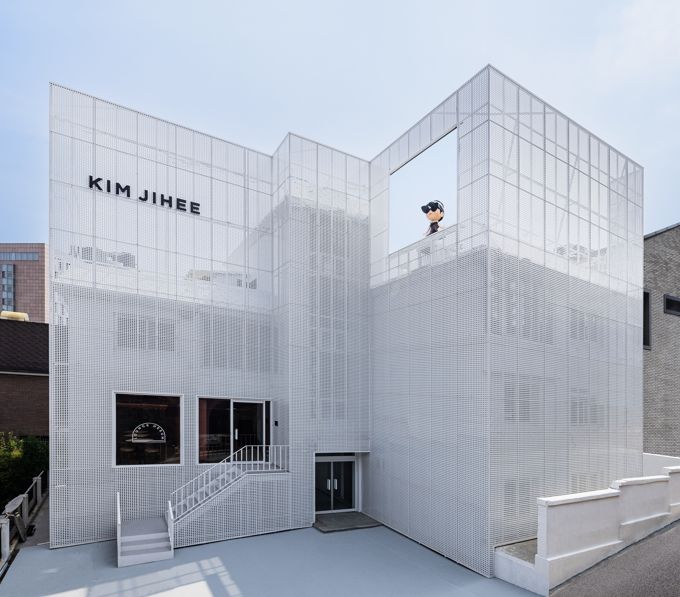
 Kim’s studio shares a building with a coffee shop and Lounge Heeum, an exhibition space dedicated to her work.
The glamorous faces embody intense expressions of desire, a theme the artist has explored since her early career, driven by a deep interest in human nature. Asked whether the faces reflect herself, she laughed it off, adding that was not necessarily the case, though some viewers have noted a resemblance.
“Life is full of expectations and obligations,” the artist said. “People pursue standardized goals, often without knowing what they truly want. They smile, believing happiness will come with achievement, but they are often unaware that such desires may stem from a sense of emptiness.”
 Describing herself as a reserved person in her earlier years, Kim said she often questioned what others took for granted, closely observing those around her. As a child, she recalled drawing a crying clown under a spotlight on a stage.
“I think I was already drawn to inner emotions and the human psyche at the time,” she said. “Over time, figures and the emotions embedded within them became a subject I would continue to carry.”
Kim’s paintings have gradually evolved in diverse ways while maintaining a consistent theme of desire, the artist said, and now include animal imagery — often symbolic projections of desire, power and wealth — such as owls and tigers.
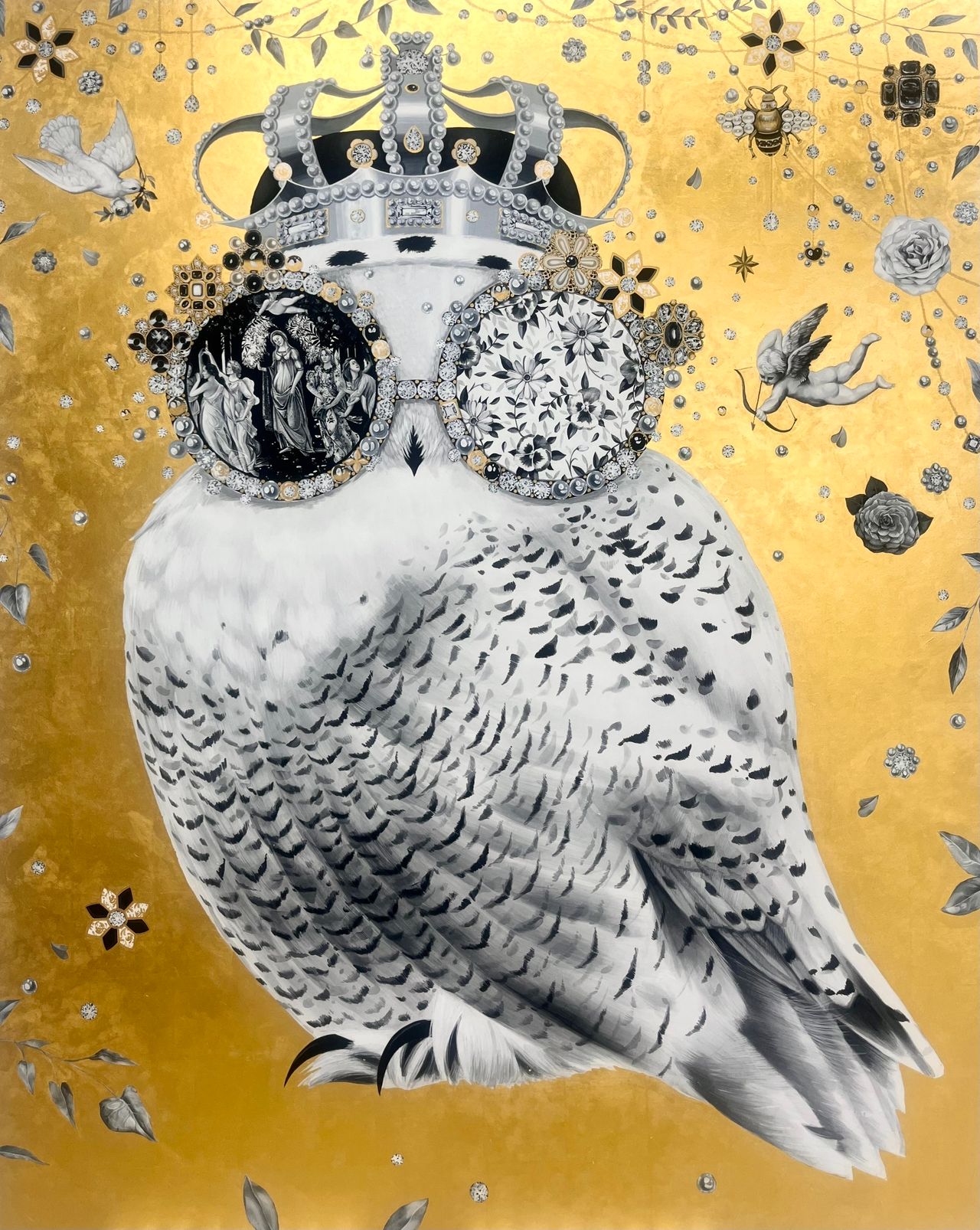 Since studying Korean painting at Ewha Womans University, Kim has adhered to traditional Korean techniques for the past 18 years, working with powdered mineral pigments bound with animal glue on jangji — a thick, multilayered form of hanji, or traditional mulberry paper. Some of her works, however, use acrylic paints, such as the “Trunk” series, whose canvases are edged with gold leaf, evoking the form of travel luggage.
Kim noted that traditional materials carry a warmth and depth she finds compelling.
“When mineral pigments are mixed with animal glue and applied in many thin layers, the surface becomes thick yet soft, almost velvety,” she said. “Jangji is often thought to be fragile, but it is actually an extremely durable material.”
Kim collaborated this year with some major luxury beverage brands, such as the blended Scotch whisky brand Royal Salute’s 55-year line. Next year, starting with a solo exhibition in January at 333 Gallery in Taipei, Taiwan, Kim is planning to embark on overseas exhibitions, including one at Kyushu National Museum in Japan in April and later in Israel, China and Indonesia.
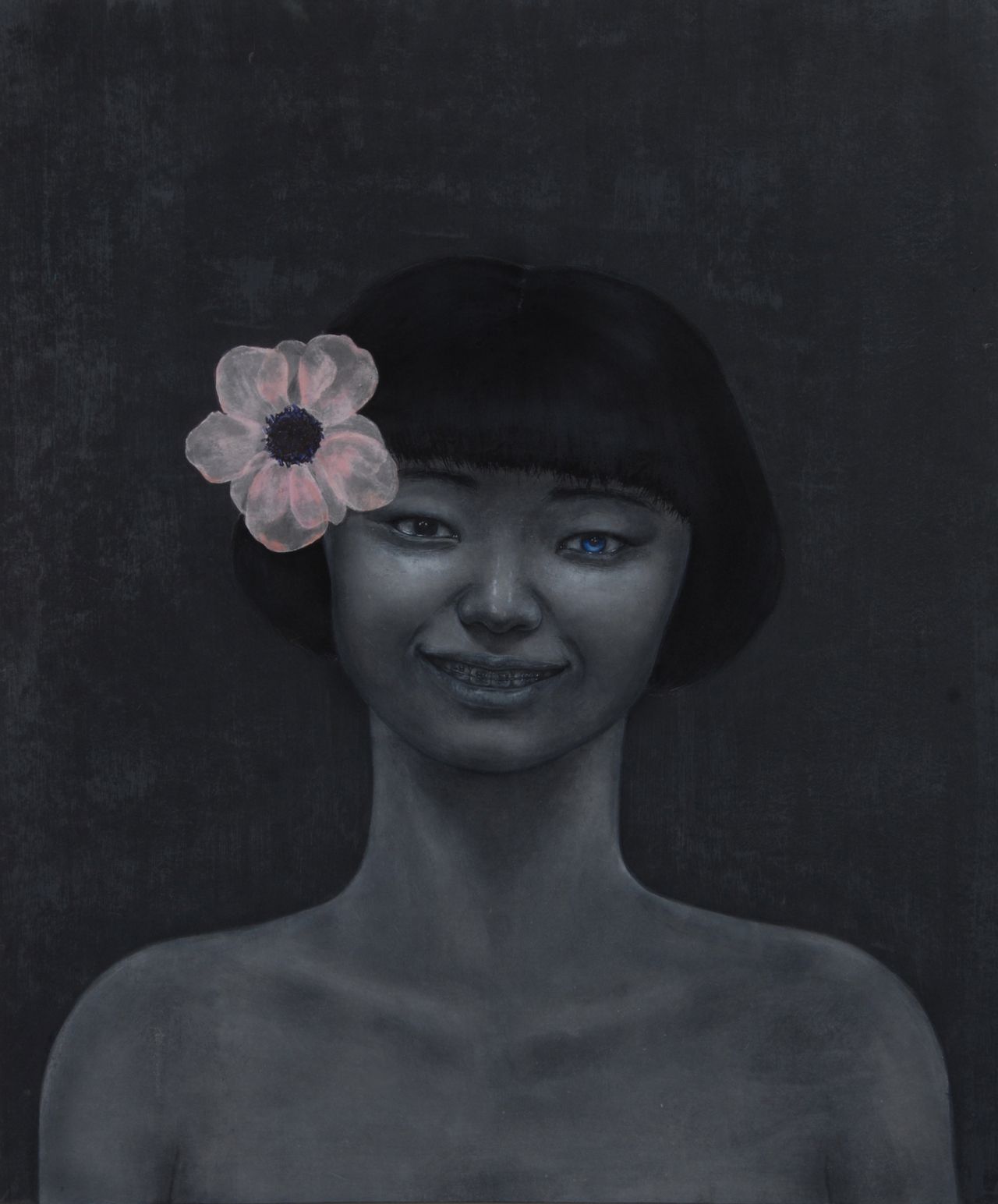
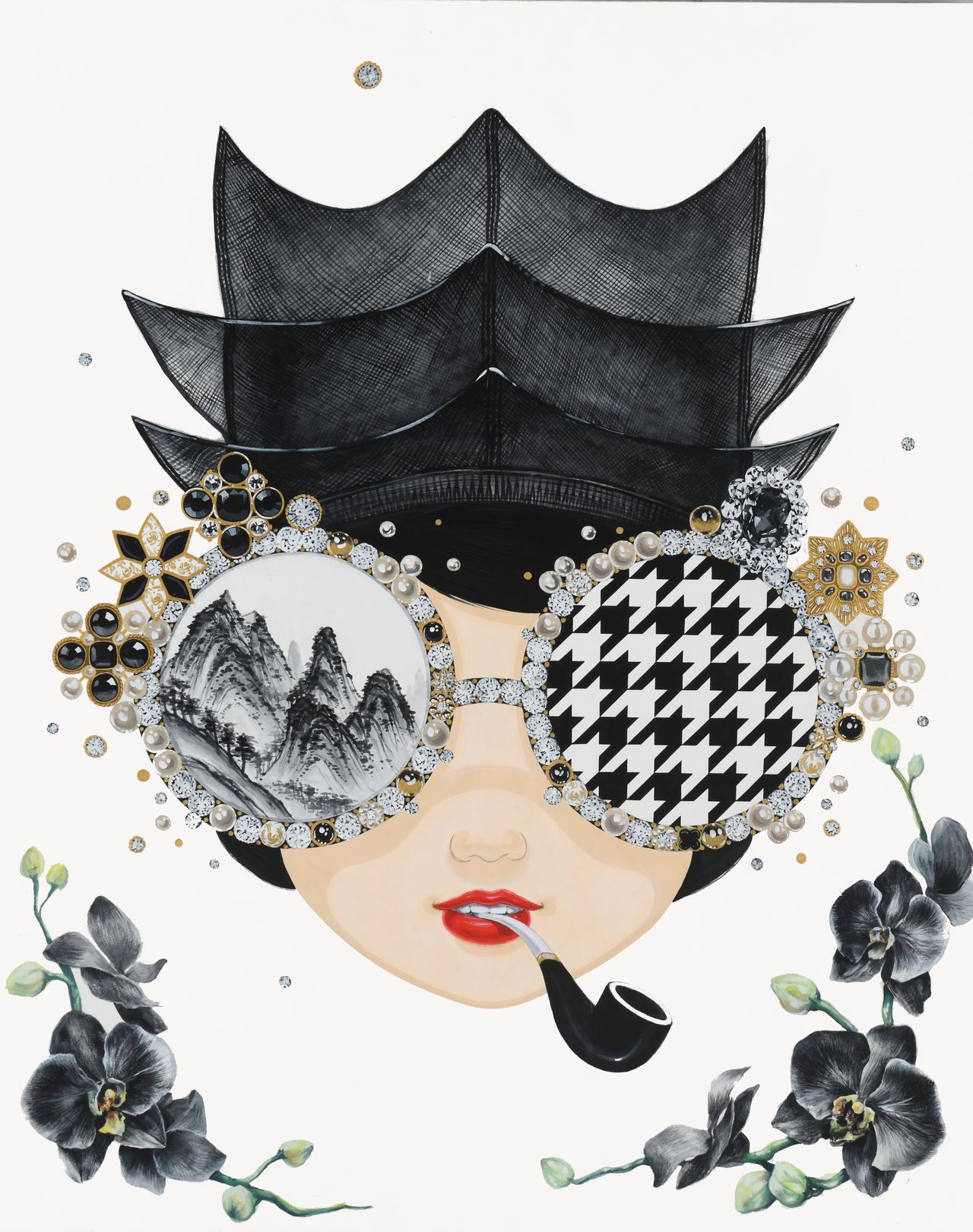 Kim’s paintings have not always been visually flamboyant. One example is a dark-toned portrait of a bob-haired girl with braces, painted on jangji in 2008. Kim, reluctant to share the work at first, describing it as overly gloomy, said she intended to convey the “sadness that comes from being different.”
“The braces on the girl were meant to express the pressure of standardized norms,” she said, adding that the girl in the painting is in fact herself.
 As the conversation delved deeper into desire and suppression, the artist took a subtle shift in perspective, asking, “Is desire always negative?” To Kim, the act of striving — of wanting intensely within a finite life — is an act of beauty in itself.
“Just because life is short doesn’t mean we should live it carelessly. Being human means we sometimes strive fiercely, and that effort to live fully can be beautiful,” Kim said. “My work ultimately speaks to a deep love for life, between desire and hope.”
- [Photo News] Nongshim lights up London’s Piccadilly Circus
- Subsidy for exiting prostitution faces backlash after viral complaint
- Ruling party chair apologizes for floor leader’s graft scandal
- SK Chemicals bolsters new drug development through open innovation
- Seventeen tops Billboard’s 2025 K-pop artist list







Most Commented