
 Hundreds of South Koreans who passed this year’s Certified Public Accountant exam have been left unable to begin their careers due to a shortage of apprenticeship placements required for license registration.
According to the Korean Institute of Certified Public Accountants, of the 1,200 candidates who passed this year’s exam, 443 had not been placed with an apprenticeship institution as of the end of October. Including passers from previous years, the number of exam-qualified accountants still awaiting mandatory training experience has risen to around 600.
To register as a certified public accountant in South Korea, applicants must pass the exam and complete at least one year of on-site training.
Miscalculation leads to oversupply
Experts largely attribute this to the government’s failure to accurately forecast demand, resulting in annual license quotas that exceed available openings.
Until 2018, the annual number of CPA exam passers, which is decided by the Financial Services Commission, had remained below 1,000 for nearly a decade. From 2019 onward, it increased that number sharply, peaking at 1,250 in 2024 before reducing it to 1,200 this year.
The expansion was based on the government’s projection that demand for CPAs would extend beyond accounting firms to private companies and public institutions, driven by increasingly stringent disclosure and compliance requirements, according to Na Cheol-ho, a former vice chair of KICPA.
In 2024, the Board of Audit and Inspection flagged a shortage of accountants in public institutions in a report, prompting the FSC to raise that year’s quota by a further 150 to 1,250.
However, Na said that didn’t translate into increased hiring of newly qualified accountants.
“In reality, neither private companies nor public institutions are hiring trainee accountants,” he said. “They prefer accountants who have already completed the minimum training period.”
Currently, structured apprenticeship training for new accountants is primarily provided by the so-called big four accounting firms: Samil PwC, Samjong KPMG, EY Hanyoung and Deloitte Anjin. Collectively, these firms only accept about 800 trainee accountants per year, creating a structural bottleneck.
What can be done?
Stung by the severity of the issue, the FSC recently sent official letters to around 100 organizations, urging them to hire trainee accountants.
In response to a local media inquiry, the agency, citing budgetary constraints, said it has no plans to take on trainees and that it already has a sufficient number of accountants.
As for next year’s exam quota, the FSC reduced the number of passers by just 50, bringing it down to 1,150.
Na of the KICPA warned that, with 1,150 new additions expected next year, South Korea will see hundreds more newly certified CPAs struggle to find employment, bringing the total unemployed trainee accountants to over 1,000.
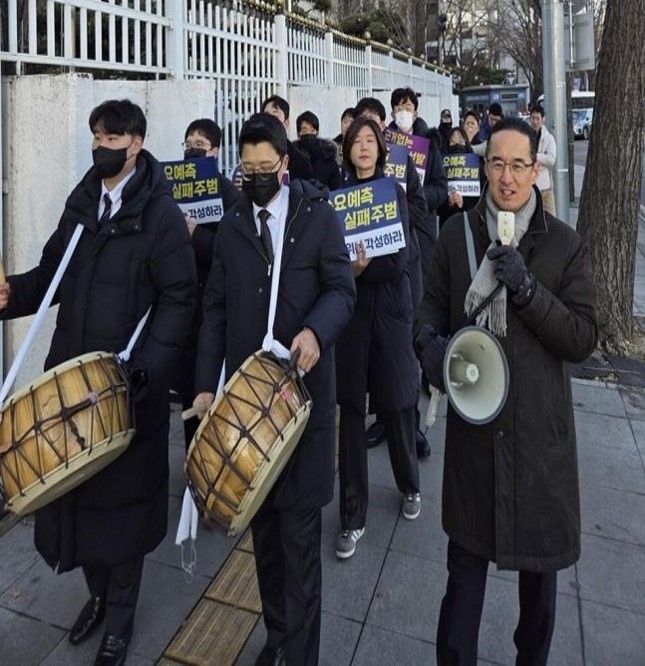
At a protest held in Gwanghwamun, Seoul, on Dec. 15, participating accountants called on the FSC to cut next year’s quota to fewer than 800, to ease the bottleneck for trainee CPAs.
The FSC has so far shown no sign that it will reduce the quota, but pledged to address ongoing challenges by expanding organizations to provide training, without providing specific details.
Kim Bum-joon, a professor of accounting at the Catholic University of Korea, said immediate measures are needed for the ever-growing number of CPA qualifiers who are shut out of essential training opportunities.
“At the very least, accounting firms should be required to provide placements so that these individuals are given a minimum opportunity,” he said.
“Some are willing to train for minimum wage or even without pay. Because without training, they cannot work as accountants at all. Training is an essential step toward becoming a CPA, but that pathway has been severed.”
Is AI to blame?
Some reports have linked the CPA job crunch to the adoption of artificial intelligence in accounting.
Industry officials and experts, however, said that while AI is likely to affect the profession in the medium to long term, the current crisis has far more to do with the government’s failure to accurately forecast demand for accounting skills. Rather than an AI-driven decline in demand, they said, the core problem has been a sharp increase in supply in the number of applicants passing the qualification exam.
Hwang noted that AI can already replace much of the work typically done by accountants with two to three years of experience.
“About half of the job involves collecting and searching for data, and the other half is organizing it and making judgments,” he said. “AI can now handle much of the data-gathering that junior accountants used to do.”
Professor Kim said that while AI technology has advanced significantly, humans are still required for accountability, verification and final judgment.
“It’s more likely that accountants who use AI will replace those who do not, rather than AI replacing accountants altogether,” he said.
- Long-delayed destroyer project shifts to competitive bidding
- Korea cuts E-9 visa quota to 80,000 for 2026
- ARKO Selection begins 18th year, continues its role as platform for new works
- Jennie unveils hangul veil at MMA 2025, spotlighting Korean aesthetics through Le Je
- Closing out K-pop 2025: Stray Kids dominate, girl groups soar


Most Commented